
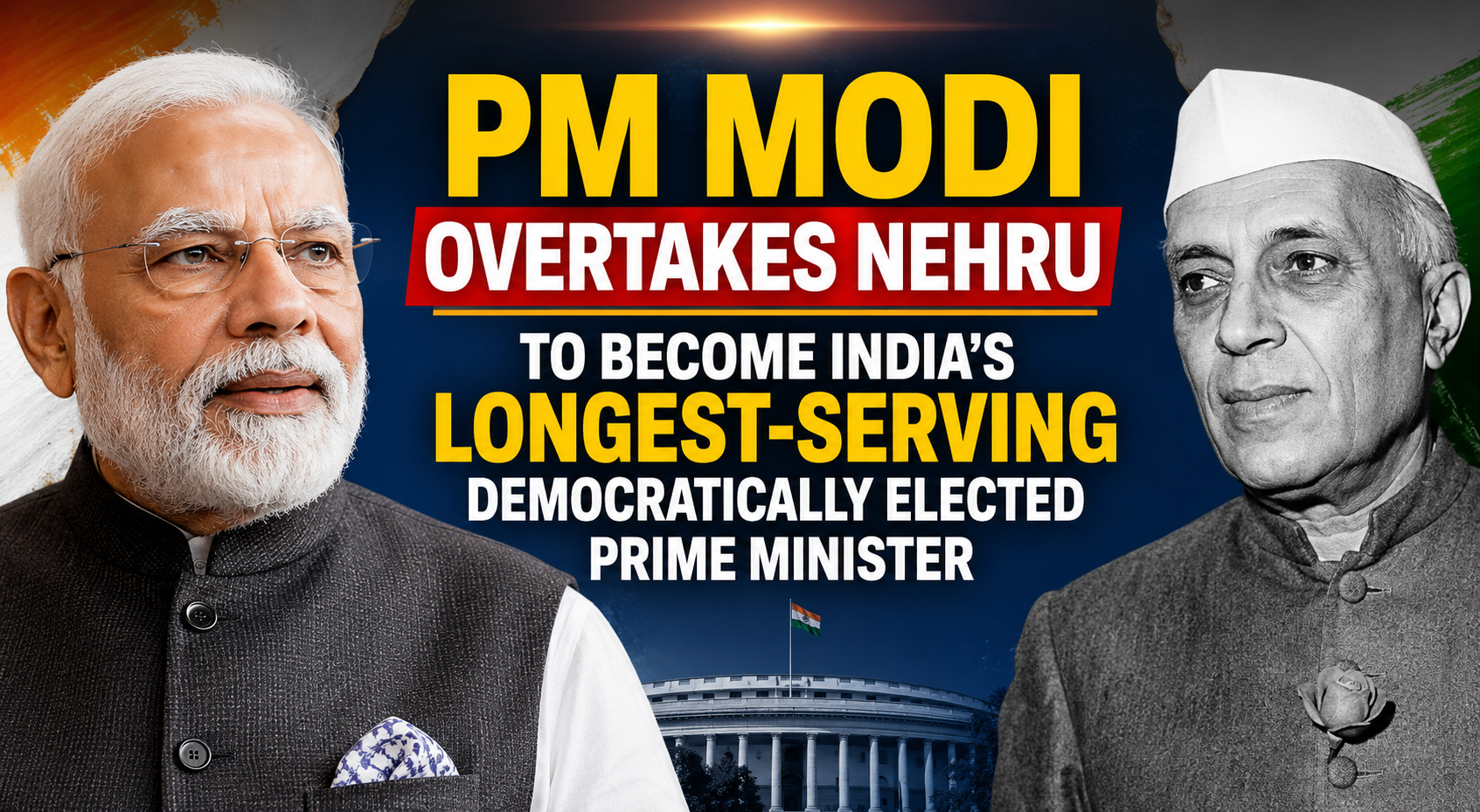
New Delhi : Prime Minister Narendra Modi has become India’s longest-serving democratically elected Prime Minister, surpassing the record held for decades by the country’s first Prime Minister, Jawaharlal Nehru. Modi completed 4,399 consecutive days in office on June 10, 2026, surpassing Jawaharlal Nehru’s record of 4,398 consecutive days as India’s longest-serving continuously elected Prime Minister
The milestone marks a significant moment in Indian political history, highlighting Modi’s uninterrupted tenure since first assuming office in May 2014. With the achievement, he has overtaken Nehru’s record for the longest continuous period served by an elected Prime Minister.
Nehru led India from August 15, 1947, until his death on May 27, 1964, laying the foundation of the newly independent nation and shaping many of its political, economic and foreign policy institutions. His tenure remained unmatched for decades.
Modi, who secured a third consecutive term after the 2024 Lok Sabha elections, has now etched his name into the record books by becoming the longest-serving elected Prime Minister in India’s democratic history.
A Decade of Political Dominance
Since coming to power in 2014, Modi has led the Bharatiya Janata Party (BJP) to three successive victories in general elections, transforming the party into the dominant force in national politics.
His tenure has been marked by major policy initiatives, including the rollout of the Goods and Services Tax (GST), the abrogation of Article 370 in Jammu and Kashmir, the expansion of digital governance, large-scale infrastructure projects, welfare schemes, and efforts to strengthen India’s global profile.
Under Modi’s leadership, India has also emerged as one of the world’s fastest-growing major economies while increasing its diplomatic and strategic engagement on the global stage.
BJP Celebrates Historic Milestone
The BJP described the achievement as a reflection of sustained public trust in Modi’s leadership. Party leaders highlighted his electoral success, governance record, and popularity across different regions of the country.
Several BJP leaders and supporters took to social media to congratulate the Prime Minister, calling the milestone a historic moment in India’s democratic journey.
Opposition Calls for Focus on Governance
Opposition parties acknowledged the record but maintained that governance performance, economic challenges, unemployment, and social issues remain the key benchmarks for evaluating any government.
Political observers noted that while records and longevity in office are significant, they ultimately become part of a broader assessment of a leader’s impact on the nation.
A New Chapter in Indian Political History
Modi’s achievement places him among the longest-serving elected leaders in the world and marks a new chapter in India’s democratic evolution.
As he continues his third term in office, the record further cements his position as one of the most influential and consequential political figures in contemporary Indian history, surpassing a benchmark that had stood since the era of Jawaharlal Nehru.
Key Numbers
- Narendra Modi first became Prime Minister on May 26, 2014
- He won consecutive Lok Sabha elections in 2014, 2019, and 2024
- Jawaharlal Nehru served as Prime Minister from 1947 to 1964
- Modi is now India’s longest-serving democratically elected Prime Minister
- He is currently serving his third consecutive term in office
Milestone Data: Modi vs Nehru
| Prime Minister | Consecutive Elected Tenure | Total Days in Office* |
|---|---|---|
| Narendra Modi | 4,399 days (as of June 10, 2026) | 4,399 days and counting |
| Jawaharlal Nehru | 4,398 days | 4,398 days |